
Korimana: Were Living Water and Ancestral Wisdom Guide Transformation
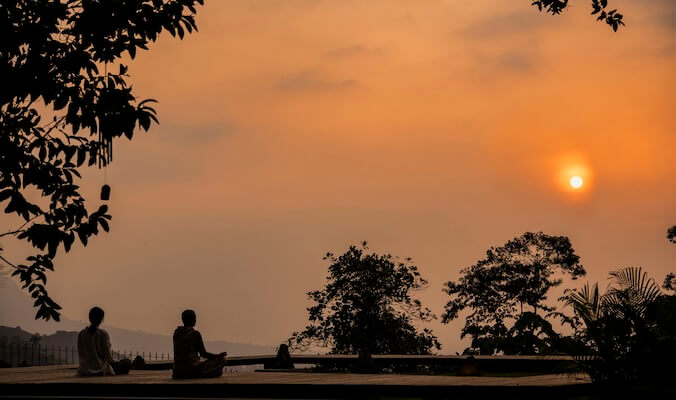
© Korimana
A Sanctuary of Sacred Return in the Heart of Ecuador
In the region of La Maná, Ecuador, where the Andes descend toward the Amazon basin, forest, rainfall, and volcanic terrain converge in continuous ecological movement. Water surfaces naturally through mineral-rich ground shaped over millennia.
Korimana was established within this landscape.
Rather than positioning itself apart from its surroundings, the healing retreat took form in response to them. Land, water, and existing cultural traditions shaped its development. The result is not a constructed escape, but a space that remains in conversation with its environment.
From the outset, the intention was not expansion, but alignment, allowing what was already present in the land to define what could emerge around it.
The Origin: Splendor Water
At the center of Korimana rises a natural spring called Splendor Water. The healing retreat developed around this source. Its presence preceded the structures that now surround it.
Emerging through volcanic terrain shaped over millennia, the water surfaces after prolonged contact with mineral-dense rock formations. Its composition reflects geological time rather than industrial treatment. The character of the water, its taste, temperature, and texture, is shaped by that process.
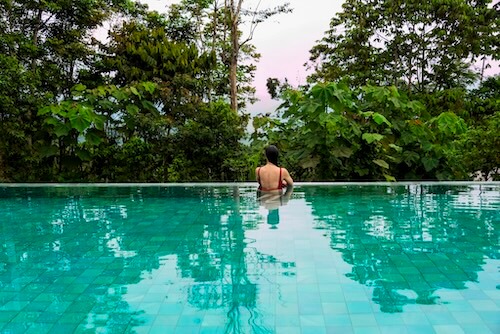
At Korimana Healing Retreat, the spring is integrated into daily life. It feeds pools and hydrotherapy circuits and is consumed throughout the property. It accompanies rest, conversation, and moments of quiet.
Across cultures, water has often been associated with continuity and renewal. Here, its role is less symbolic than experiential. It is encountered directly, through immersion, sound, and hydration, allowing each person’s response to remain their own. The emphasis is not on interpretation, but on proximity.
Ancestral Lineage
Korimana’s work extends beyond landscape into traditions that have long existed in this region of Ecuador.
In many indigenous cosmologies, healing is approached not as intervention, but as restoration of balance. The role of the shaman or curandero is traditionally that of facilitator, accompanying processes rather than directing them.
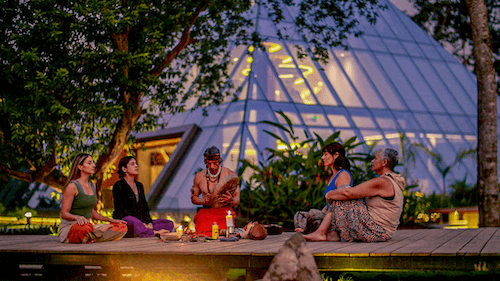
At Korimana, ceremonial practices such as sweat lodge purification, meditation, sound work, and plant-based rituals are held within structure and lineage. They are not framed as spectacles, but as expressions of continuity within cultural context.
The surrounding forest forms part of this environment. Ritual does not occur apart from the land, but within it, accompanied by natural sound, shifting light, and the presence of water. Alongside these ancestral practices, contemporary modalities such as yoga, meditation, therapeutic bodywork, and guided inner process are present. The emphasis remains on pacing and integration.
Transformation is not positioned as dramatic. More often it unfolds as subtle recalibration, steadier breath, clearer perception, renewed proportion.
Ecuador’s traditions remain living rather than preserved artifacts. Korimana exists within that continuity, not outside of it.
Architecture in Context
The built environment at Korimana follows the contours of the land rather than overriding them. Locally sourced materials are used throughout, and structures remain open to air, light, and surrounding vegetation.
Design decisions reflect an intention toward continuity rather than contrast. Geometry and spatial orientation respond to terrain and climate. The glass pyramid stands within the landscape as a gathering structure, not as monument, but as part of the broader ecological setting.
Silence is preserved where possible. Mechanical sound is minimal. Forest, sky, and shifting light remain present from most vantage points. Rooms are designed for simplicity and privacy. The emphasis is on proportion, natural texture, and unobstructed connection to the environment.
Architecture does not seek to dominate the land. It remains in conversation with it.
A Return, Not an Escape
In a time when experiences are often designed for intensity and visible outcomes, remaining in one place, in sustained proximity to land and water, introduces a different rhythm.
At Korimana, days are structured less by urgency and more by continuity. Light changes gradually. Sound remains organic. Silence is not absence, but presence. Within that atmosphere, shifts tend to be quiet rather than dramatic. Attention settles. Breathing deepens. Perspective adjusts. Return here is not framed as escape from life, but as recalibration within it.
What remains is not spectacle, but proportion.