
How Historical Lessons Lend a Perspective on Our Own Personal Challenges

© Ken Cheung
In our modern quest for mental and spiritual wellness, we often look inward, searching for the root of our anxiety or the key to our fulfillment. We meditate on our breath, journal our feelings, and dissect our childhoods. While this introspection is vital, there is another powerful, yet often overlooked, source of healing: looking backward. By studying the lives of those who came before us, we can find a profound perspective on our own struggles.
History is not just a collection of dates and dusty artifacts; it is a vast tapestry of human experience, woven with threads of triumph, failure, fear, and courage. When we view our personal challenges through this long lens, our problems, while still valid, are placed in a context far larger than ourselves. We realize we are not the first to feel lost, to be ridiculed, or to face the seemingly impossible.
This very concept is the inspiration behind my upcoming deck Legends, Heroes and Villains Oracle. This tool is designed to help you draw wisdom from the archetypal figures of the past, connecting their monumental journeys to the subtle landscapes of your daily life. Let’s explore this through two such figures from the deck: a pioneering scientist and a revolutionary thinker.
The Discovery of Self-Worth
When we face personal challenges—be it a creative block, a career setback, or a crisis of confidence—the lesson is often not to find something new, but to uncover a truth that was buried within us all along. This is the energy of the card for Marie Curie, whose keyword is Discovery.
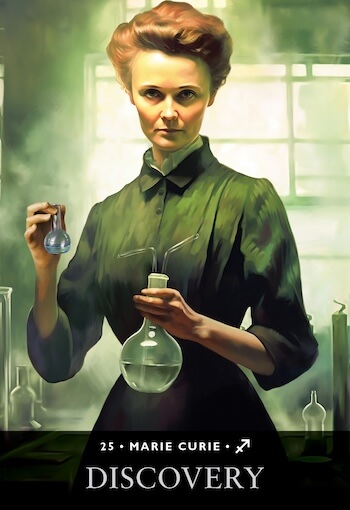
On the surface, Curie’s discovery of radium and polonium changed the course of science. She was the first person to win two Nobel Prizes in different scientific categories. But beneath the accolades lies a spiritual lesson in perseverance and self-trust. Curie’s quest for discovery was not handed to her on a silver platter. As a young woman in Russian-controlled Poland, she was barred from attending university. She worked for six years as a governess, sacrificing her own comfort to fund her sister’s education, all while secretly studying in her spare time, waiting for her own opportunity.
When she finally made it to Paris, she and her husband Pierre worked in a poorly ventilated shed, processing tons of pitchblende ore to isolate a minute amount of a new element. The work was physically demanding and, as we now know, lethally dangerous. Yet, Curie wrote, “I was taught that the way of progress was neither swift nor easy.”
In the context of your own life, Marie Curie’s story is a testament to the discovery of your own latent strength. When you feel your spirit is being crushed by external circumstances—a dead-end job, a toxic relationship, or self-doubt—remember Curie in her leaky shed. She teaches us that discovery is not about stumbling upon something new but about having the fortitude to extract the precious element of your own potential from the heavy ore of your daily grind. She famously said, “Nothing in life is to be feared, it is only to be understood. Now is the time to understand more, so that we may fear less.” Your personal challenges are simply an invitation to understand yourself more deeply.
The Truth That Sets You Free
Perhaps the most isolating of human experiences is holding a belief that the rest of the world deems foolish or heretical. Whether it’s choosing an unconventional path, speaking out against injustice, or simply living your truth in a judgmental environment, the fear of standing alone can be paralyzing. For this, we turn to the second figure from the deck: Nicolaus Copernicus, whose keyword is Truth.

In the early 1500s, the world “knew” that the Earth was the center of the universe. This was not just scientific fact; it was religious doctrine and societal bedrock. Copernicus, a polymath and cleric, dared to look at the math and the stars and conclude otherwise. He proposed a heliocentric model—that the sun, not the Earth, was at the center of our solar system. He understood the weight of this truth and the danger it posed to his reputation and safety. For decades, he hesitated, sharing his ideas only with close friends, for “fear of the scorn to which he would expose himself on account of the novelty and incomprehensibility of his thesis.” It was only near his death in 1543 that he published his groundbreaking work De Revolutionibus Orbium Coelestium.
In your personal life, you may be facing your own “Copernican shift.” You might be realizing that the world you built (your “geocentric” view) is not, in fact, the center of the universe. Perhaps the job you dedicated your life to no longer fits, or a longheld family belief is causing you more pain than peace. To hold onto this new truth can feel like uncentering your entire world. You may face ridicule or pushback from those who are comfortable with the old model. The spiritual lesson of Copernicus is not just about being right; it is about the courage to hold your center when your world has been “uncentered.” It is trusting that a deeper truth exists, even if you are the only one who sees it, and even if you can only whisper it at first.
Takeaway
Marie Curie teaches us to persist in the slow, often painful work of discovering our inner radiance. Nicolaus Copernicus challenges us to have the courage to recenter our lives around a deeper truth, even when it defies the consensus of those around us.
Their stories remind us that our personal challenges—the long nights of work, the fear of speaking our truth—are threads in a timeless human fabric. We are not alone. We are walking a path worn smooth by the footsteps of legends. By looking to them, we gain the perspective to navigate our own journey with a little more grace, a little more courage, and a lot less fear.