
JustBreathe

a magazine by HEALING HOTELS OF THE WORLD

  • Body
    • Health
    • Ayurveda
    • Detox
    • Anti-Stress
    • Beauty
    • Healing Water
    • Graceful Aging
    • Weight Loss
    • Fitness
    • Sleep
  • Mind
    • New Consciousness
    • Mindfulness
    • Meditation
    • Yoga
  • Soul
    • Spirituality
    • Food for Your Soul
    • Me-Time
  • Life
    • Holistic Lifestyle
    • Inspirational Podcasts
    • Inspiring People
    • Green Living
    • Charity
    • Design
  • Food
    • Nutrition
    • Recipes
  • Healing Hotels
Close
JustBreathe
Close
  • Body
    • Health
    • Ayurveda
    • Detox
    • Anti-Stress
    • Beauty
    • Healing Water
    • Graceful Aging
    • Weight Loss
    • Fitness
    • Sleep
  • Mind
    • New Consciousness
    • Mindfulness
    • Meditation
    • Yoga
  • Soul
    • Spirituality
    • Food for Your Soul
    • Me-Time
  • Life
    • Holistic Lifestyle
    • Inspirational Podcasts
    • Inspiring People
    • Green Living
    • Charity
    • Design
  • Food
    • Nutrition
    • Recipes
  • Healing Hotels

What Ayurveda Has to Say About Wine
Ayurveda, Body, Healing Hotels November 3, 2026 Mandabi Guha
What Ayurveda Has to Say About Wine

© Hotel Le Cep, France

At Hôtel Le Cep, in the heart of Burgundy’s wine region, two traditions meet in an unexpected place: the pleasure of wine and the discipline of Ayurveda. Rather than treating the two as opposites, the hotel’s Ayurveda Center at Spa & Centre Holistique Le Cep looks at wine through an Ayurvedic lens, asking not whether to drink, but how, when, and how much.

While wine can heighten the pleasure of sensory experience, alcohol may also lower inhibitions and diminish self-control, altering our perception and our connection with the present moment.

In Ayurveda, alcohol is referred to as Madya and is traditionally discussed for its potential effects on digestion, circulation, and the Doshas (the three fundamental biological principles: Vata, Pitta and Kapha), depending on its potency, quantity, and the individual’s Prakruti (innate birth constitution). Much like the philosophy of wine tasting, Ayurveda invites us to consider not only what we consume, but also how, when, and in what measure.

Through the perspective of Ayurveda, Madyapanam (consumption of alcohol) invites us to explore the delicate interplay between Vata’s (air and ether) movement, Pitta’s (fire and water) heat, and Kapha’s (water and earth) stability, reminding us that the pleasure of wine must be understood in relation to Prakruti, moderation and mental clarity.

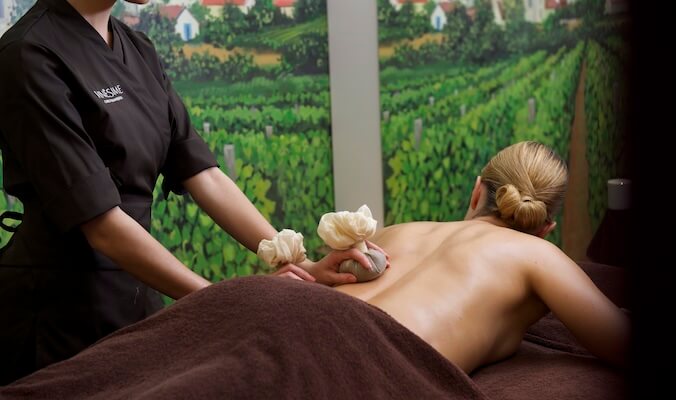
At Spa & Centre Holistique Le Cep, Ayurveda is offered through a variety of signature retreat programs combining yoga, meditation, Ayurvedic rituals, herbal baths and balanced vegetarian meals at the restaurant LunchBox. Wine and Ayurveda coexist here when the pleasure of wine is approached with mindfulness, moderation and awareness of one’s own constitution, treating sensory enjoyment and holistic wellbeing as complementary rather than opposed.

Ayurveda and Wine

One of the most important classical texts of Ayurveda, Charaka Saṃhitā (Cikitsā Sthāna 24: Madātyaya Cikitsā), provides insight into how Ayurveda understands the body, mind, health, disease and longevity. Alcohol is traditionally described as having heating, sharp and penetrating qualities. In Ayurvedic interpretation, these qualities may initially stimulate appetite but can aggravate digestive discomfort and disturb digestive balance when drinking is excessive.


Effects on the body

  • Vata (air and ether): its drying and irregular effects may aggravate Vata, associated with restlessness, disturbed sleep and instability.
  • Pitta (fire and water): alcohol’s heating quality may aggravate Pitta, associated traditionally with heat, irritability and acidity.
  • Kapha (earth and water): its light, penetrating qualities may temporarily counter some Kapha characteristics, but alcohol is not a recommended way to balance Kapha.
  • Ojas: Ojas represents the body’s vital essence, associated in Ayurveda with strength, resilience and stability. Classical texts describe excessive alcohol as opposing the qualities of Ojas. In modern terms, chronic heavy drinking can impair nutrition, immunity, sleep and multiple organ systems; Ojas is a traditional concept, not a measurable biomedical one.


Effects on the mind

Ayurveda considers the mind (Manas) closely connected with the body’s overall state. Alcohol’s effects can be understood through three traditional mental qualities, the Gunas.

  • Sattva, clarity and harmony: associated with mental clarity, calmness and discernment. Intoxication can impair clear perception and sound judgement, moving a person away from these qualities.
  • Rajas, stimulation and agitation: alcohol may initially produce excitement, talkativeness, confidence or impulsivity. As its effects develop, emotional reactions and risk-taking can increase.
  • Tamas, heaviness and dullness: with greater intoxication, a person may experience confusion, reduced awareness, sluggishness or eventually unconsciousness.


From metabolic overload to balance

Guests who want to put these principles into practice can do so through the hotel’s Ayurveda detox program, built around five classical purification steps: Āmapācana (toxin removal), Agni Deepana (rekindling digestion), Koṣṭhaśuddhi (intestinal cleansing), Kāyaśuddhi (body cleansing) and Rasayana (rejuvenation). Each stay opens with a medical screening and Ayurvedic consultation, moves through personalized treatments such as traditional Abhyanga massage alongside daily yoga and pranayama, and closes with a follow-up consultation and long-term lifestyle plan before departure.

Full program details and booking are available on the Panchakarma Program page.

The aim isn’t only to eliminate alcohol or detoxify the body. It’s a ritual of relaxation, hydration and sensory renewal.

At Healing Hotel Hôtel Le Cep, wine remains an invitation to the senses, and Ayurveda offers a way to meet that pleasure with awareness rather than excess. Together, they suggest a different kind of indulgence, one measured not by how much is consumed, but by how fully it is noticed.

As we bring together the wisdom of Ayurveda and the art of wine, may we remember that true wellbeing lies not only in the pleasures we experience, but in the harmony we cultivate within ourselves.


Lokah Samastah Sukhino Bhavantu

A Sanskrit mantra from Vedic texts which means may all beings everywhere be happy and free, and may the thoughts, words and actions of my own life contribute to that freedom and happiness.


 

Tags: Ayurveda Healing Hotels healing travel panchakarma wine

Leave A Comment Cancel reply

Your email address will not be published. Required fields are marked *

This site uses Akismet to reduce spam. Learn how your comment data is processed.

justbreathemag

An online magazine by @healinghotels created to change minds, habits & hearts 💛
#HealingIsLove #Health #Wellbeing
Click below for all articles ⬇️

“The opposite of self-abandonment is not self-impr “The opposite of self-abandonment is not self-improvement. It is a relationship with self.”

For years, @shannonkaiserwrites put everyone else’s needs first and thought she was simply easygoing. Then she ended up in an emergency room.

In her new piece for Just Breathe, she explains how people-pleasing keeps the nervous system on constant alert, how that feeds chronic stress and burnout, and the simple hand-on-heart practice that helped her come back to herself.

🌿 Read the full article via the link in bio.
„We learned early in life that someone else knew b „We learned early in life that someone else knew better than we did.“

Kelly Kolodney, known as „The Angel Lady,“ has spent nearly four decades helping people find their way back to their own inner knowing.

In a new conversation for Just Breathe Mag, she speaks about the exhaustion so many of us carry without naming it, the small practices that begin to settle a restless mind, and what it takes to trust yourself again.

Read the full interview. Link in bio.

With @kelly_theangelraphael

#Intuition #Grounding #SelfLove #EmotionalWellbeing #DailyPractice
🌙 Jung wrote his Red Book in secret between 1914 a 🌙 Jung wrote his Red Book in secret between 1914 and 1930. It stayed unpublished until 2009. A century on, its warning still lands: when politics becomes a substitute for spirituality, the soul is the first thing we neglect.

In our latest essay, Maria Ushakova traces Jung’s path of individuation, the slow work of coming to know your own depths, and asks what becomes of our mental health when we look for meaning only in comfort, recognition, and wealth.

Asked late in life whether he believed in God, Jung answered: „I don’t need to believe. I know.“ ✨

Read the full piece. Link in bio.
„It whispers before it screams.“ In a new convers „It whispers before it screams.“

In a new conversation for Just Breathe Mag, Dr. Peter Moosbrugger of @sonnenberg.health.hotel explains why illness so often takes hold long before we feel it, and what it means to start listening to the body earlier.

Sonnenberg Health Hotel is a healing hotel set high in the Swiss Appenzell hills, 972 metres above the village of Schwellbrunn. Rooted in the Biological Medicine of Dr. med. Thomas Rau, it treats the body’s own ability to regulate and regenerate as the centre of every stay. Clean mountain air and deep quiet meet a purely plant-based, gluten-free kitchen and a medicine that looks for the cause rather than the symptom.

Read the full interview at justbreathemag.com (link in bio).

📍 Sonnenberg Health Hotel, Schwellbrunn, Switzerland

#HealingHotels #SonnenbergHealthHotel #BiologicalMedicine #HealingTravel #HealingJourney
There is a quiet moment, somewhere after the secon There is a quiet moment, somewhere after the second or third day of fasting, when the body lets go of glucose and turns to ketones instead. Something shifts. Hunger softens. The mind clears. And the noise of constant eating gives way to a deeper kind of listening.

Just Breathe Mag’s latest article follows that shift with the physicians of Marienkron Retreat and Health Resort, Dr. Ulrike Göschl and Dr. Martin Krizmanits, who gently separate what fasting truly offers from the myths that cling to it: the fear of starvation, the harsh detoxes, the truth about coffee, and why longevity is less about how long we live and more about how fully.

A collaboration between @healinghotelsoftheworld, @justbreathemag and @marienkron.

Read the full article. Link in bio.

#Fasting #Longevity #HealingHotels #Marienkron #JustBreatheMag
Follow on Instagram

About JustBreatheMag

Just Breathe is an online magazine that was created to change minds, habits and hearts on the most important and current topics: health and wellbeing.

Powered by

Healing Hotels of the World Logo

Popular Tags

ageing anxiety Ayurveda balance beauty breath consciousness coronavirus detox diet DIY fear Fitness gratitude happiness healing Healing Hotels HEALING SUMMIT health healthy nutrition holistic health inspiration intention Life lifestyle love me-time Meditation mental health mindfulness nutrition podcast recipe self-love self-reflection self care sleep spirituality stress sustainability transformation Travel weight loss wellbeing yoga

Behind the Scenes

  • Article Submission
  • About Us
  • Contact

Newsletter Signup

* indicates required
Legal Info | Privacy Policy | Terms & Conditions | Cookie Settings